Trade-in
The new fleet pays for part of itself
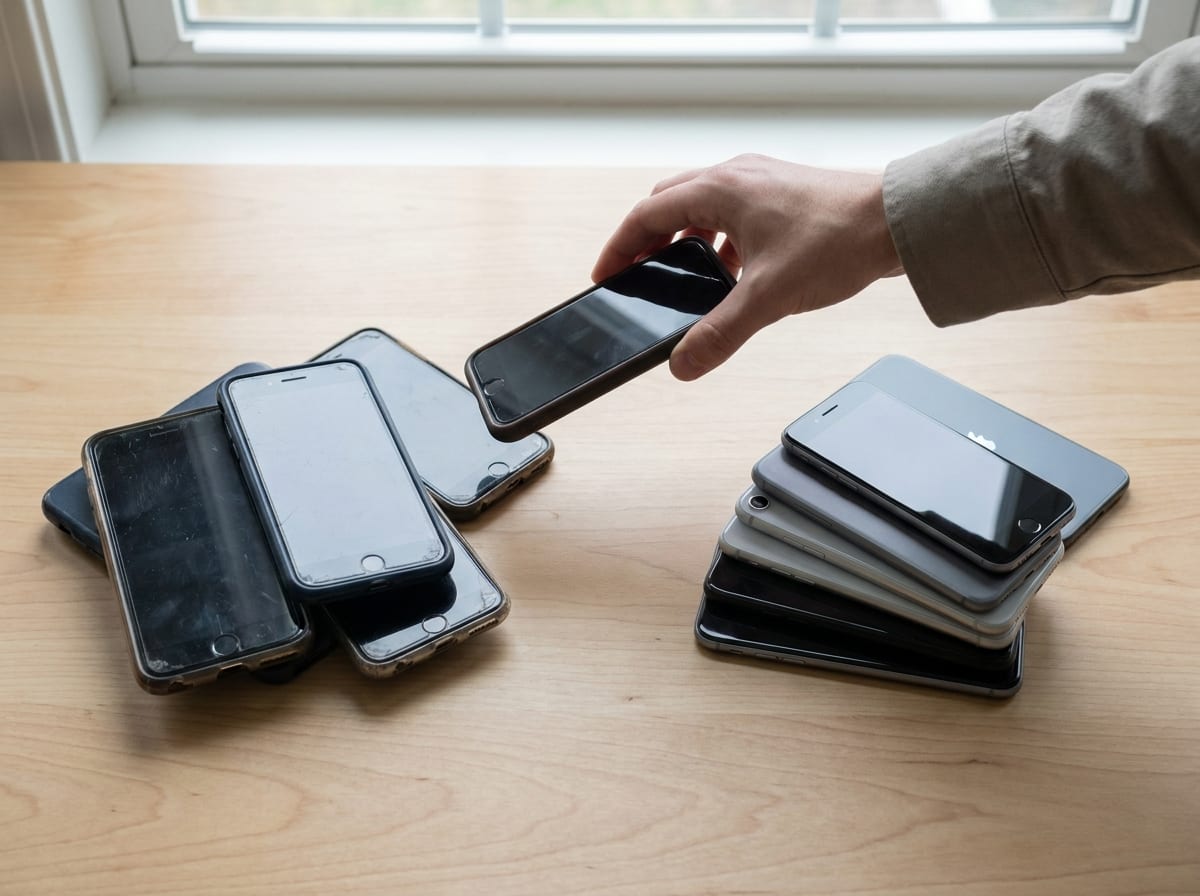
A fleet renewal creates two jobs that usually run separately: buying the new devices and getting rid of the old ones. A trade-in puts them together. We value the old devices before the new ones are rolled out, hold that price, and offset the residual value against the purchase.
The difference
A trade-in is not the same as a purchase
Either way we end up taking your old devices. The difference is the timing and how firm the price is.
| Purchase | Trade-in | |
|---|---|---|
| Trigger | the devices are already out of service | the new purchase is decided, the devices are still in use |
| Valuation | once the devices reach us | up front, from your stock list |
| Price | the going rate on the day of collection | held until the agreed rollout date |
| Sequence | one pass | two waves: valuation first, devices back after the rollout |
| Right for you if | the cupboard is full and you need the space | you want the residual value in your investment case |
The process
Seven steps in two waves
The rollout must not wait for us, and nobody should be left without a device. That is why the sequence is built so that old and new overlap.
Stock list
You send models, storage sizes and quantities — usually a matter of minutes to export from your MDM.
Valuation
We price each model under two condition assumptions and give you a range.
Price held
You receive an offer with a validity date, set against your rollout date.
Preparation
We agree how devices are released: MDM, Business Manager, user accounts, SIM cards.
Rollout
Your staff receive the new devices. The old ones go into the return flow.
Return
Collection on a single date or staggered by site, with a count record.
Settlement
A credit note per device. Anything that differs from the assumption is itemised.
Facts
What you should know about residual values
Six things that decide in practice what you get for the devices — and they apply no matter who you do the exchange with.
Time is the biggest lever
Used smartphones lose value fastest once the successor model is announced. An exchange that happens a quarter later brings noticeably less, without anything having changed about the device.
Locks destroy value
A device still tied to Apple Business Manager or to an MDM is close to unsellable on the secondary market. It is the most common and most expensive mistake in a fleet renewal — and entirely avoidable.
Identical units earn more
Fifty identical devices can be priced differently from fifty different ones. Buying few variants in the first place already improves the residual value later on.
Completeness adds up in volume
On its own a charger, a stylus or a dock is small change. Across a whole fleet it adds up to a line item that more than covers the logistics.
Condition is rarely the problem
Signs of use reduce the price moderately. A broken display costs considerably more, water damage most of all. For planning purposes: count the damaged devices separately rather than estimating them.
Erasure is not a side step
Your company remains responsible for the data. That is why every trade-in comes with an erasure record per device — not a confirmation that a delivery arrived.
Worked example
How the numbers come out
One case worked through, so the order of magnitude is visible. The figures are an example and not a price list — your offer depends on models, condition, quantity and timing.
| Item | Amount |
|---|---|
| New purchase of 200 smartphones (example price 700 € per device) | 140,000 € |
| Trade-in of 200 old devices, three years old, mostly grade B example value 145 € per device |
− 29,000 € |
| of which 12 devices with a broken display, valued separately example value 40 € instead of 145 € |
+ 1,260 € |
| Investment after the trade-in | 112,260 € |
| Saving against buying without a trade-in | around 20 % |
What the example shows
- The residual value of a fleet still in service is not a rounding error but a double-digit percentage of the new purchase.
- Damaged devices belong in a separate count — otherwise the average drags the whole valuation down.
- The figure belongs in the budget proposal, not in the review afterwards.
And the environmental side
Reusing 200 smartphones avoids roughly 9 tonnes of CO₂e against new production, by our calculation. For sustainability reporting we can state that per job.
Enquiry
Request a trade-in
To quote something you can rely on we need models and quantities. An export from your MDM is the fastest route — send it afterwards to info@smd-tech.de.
To keep things moving
- Models with storage size — on smartphones that is the largest price factor
- How many devices have a broken display or a fault, counted separately
- The sites we should collect from
- Your rollout date, so the price is held for the right period
Rather talk it through?
For fleets over 500 devices or several sites we sort the logistics out faster by phone than through a form.
Questions
Frequently asked about trade-ins
How long does a trade-in offer stand?
We hold the price for a period agreed with you, normally up to your planned rollout date. If the rollout slips substantially we value again — and we say so beforehand, not afterwards.
What happens if a device is in worse condition than assumed?
That device is valued again on its own and the difference is shown in the settlement, with its identifier so you can follow it. We do not apply blanket deductions across the whole batch.
Can staff keep or buy their old device?
That is your decision. Some companies offer the old devices to staff and put only the remainder into the trade-in. Tell us the quantity that will actually come back and we will price that.
Do we have to erase the devices ourselves?
No. You do have to release them from device management and from user accounts — only you can do that. We handle the data erasure and document it per device.
Does a trade-in work with leased devices?
Only if your lease allows you to take ownership. There is often a purchase option at the residual value that is cheaper than the secondary-market value — in that case taking ownership and trading in pays off. Check the contract and we will compare both routes.
Do we get figures for our sustainability report?
Yes. We state how many devices went back into use and how many were recycled, and calculate the avoided emissions with the method documented openly in the CO₂ calculator.
Rollout in sight?
The best moment for a valuation is before the purchase is signed off. Then the residual value is already in the proposal.